
Church Of Saint Aquilina the Martyr
Aquilina was born in the city of Byblos in the year 281 and was martyred there at the age of twelve during the reign of the Roman Emperor Diocletian and the governor of Byblos, Volusianus, in the year 293. She was mentored by the bishop of the city, Otalios. Thanks to her dedication to spreading the principles of the Christian faith, a significant number of pagans, especially young boys and girls, converted to Christianity.
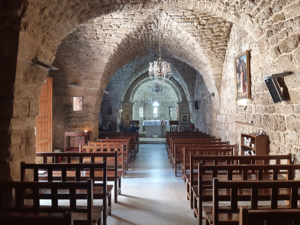
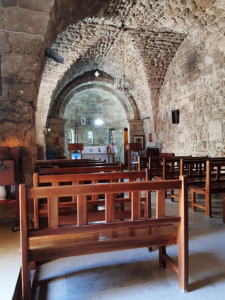
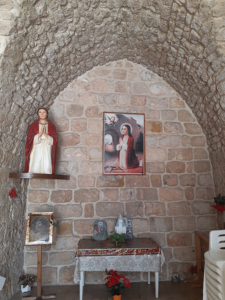
The relics of the martyr Aquilina were buried outside the city of Byblos, and it is believed that the small shrine built in her name, located on a hill east of Byblos in the Qassouba neighborhood, is the site of her tomb. Only ruins of this temple remain, where the people of Byblos gather for prayer and blessings, which motivated them to revive and rebuild it. It was restored in 1995. The French orientalist Ernest Renan states that Aquilina was buried outside the walls, near the Church of Our Lady of the Gate. The Lebanese monk Father Antonio Zgheib wrote her biography and composed prayers and hymns for her, and he commissioned the painter Semaan Sarah (known as Semaan the Illustrator) to paint a portrait representing the martyr Aquilina, which is the sole reference for all her depictions. Based on this information, Father Louis Khalifeh, when he was the head of the Antonine Order, worked to promote her veneration and sought her intercession, dedicating a room for her in the basement of the Antonine Monastery in 1976, in anticipation of the construction of a temple and shrine specifically for her. Thus, Aquilina’s veneration returned to the forefront, but with great fervor.
During his tenure as head of the Antonine Order in Byblos, Father Yuhanna Wehbeh showed great interest in honoring Aquilina, which was warmly welcomed by the merchants of Byblos, especially Mr. Butrus Al-Ottayek, who owns a men’s tailoring shop and fabric trade in the old market of Byblos and placed a portrait of the martyr Aquilina on the facade of his shop. He sought the support of the merchants of Byblos to develop and solidify the veneration of Aquilina. Thus, their efforts led to the construction of a shrine for the martyr in the wall of his shop in 1982. With the establishment of the shrine, the merchants of Byblos, with the help of the head of the Antonine Order, Father Maroun Garios, called for officially naming the street in front of the temple after Aquilina, which took place on December 18, 1987. Since then, it has become a custom to hold a contemplative procession and prayer on the feast day of the martyr on June 13, starting from the Cathedral of St. John Mark, passing through the old market, and reaching Aquilina Street, where the Divine Liturgy is celebrated in celebration of the occasion.
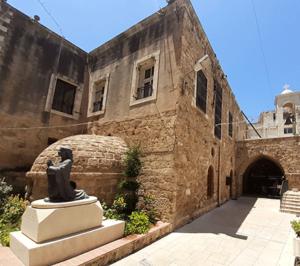
The individuals working on the development and expansion of the shrine and the honoring of the martyr Aquilina have been increasing in number and activity, with the encouragement and support of the head of the Antonine Order, Abbot Tanios Nehme. Two adjacent commercial properties belonging to the Monastery of Our Lady of Al Maounat were vacated with the aim of converting them into a proper temple for the martyr. On June 13, 1994, the painting representing Aquilina was transferred from her shrine in the Antonine Monastery to the new temple. The work is ongoing to complete the construction of the temple and furnish it. In 2005, the exterior courtyard of the temple was rehabilitated, paved, and beautified.
The people of Byblos celebrate the feast of their martyr, Saint Aquilina, on June 13th every year. The Divine Liturgy is held on her street on the eve of the feast, concluding a procession that starts from the Cathedral of St. John Mark. On the day of the feast, the Divine Liturgy is celebrated in the morning and evening at the temple. Additionally, a Mass is held in the temple every Friday throughout the year.