
History
The situation in the fortress and city of Jbeil concluded with the surrender of a group of ‘Tufankjiyya’ led by Eid Agha. They had caused corruption among the city’s residents to the extent that they expelled the Hussamites, despite the latter being Sunni, due to their sympathy with Prince Yusuf. Furthermore, they transformed the Church of Saint John Mark into a ‘stable’ for their horses. The prince laid siege to the town.
The town’s walls were old and robust, and its citadel was fortified, making it impervious to the country’s forces. It was then that the head of the monastic order, Father Emmanuel al-Rashmani, approached Sheikh Saad al-Khoury and proposed the occupation of the town with its monks, with the condition that all the city’s churches remain under the control of the monks. After consulting with Sheikh Saad, Prince Yusuf agreed to the request.
Sheikh Saad gathered his monks in the evening, and their number exceeded two hundred. After having dinner, they retired early. In the dead of night, they woke, prayed, and then made their way to the gate of Tyre, where they climbed with the aid of their leather belts. They opened the city’s gate for the prince’s army, which entered victorious, and the remaining garrison surrendered.
Indeed, Prince Yusuf granted them all the churches in Jbeil as a perpetual endowment. They cleaned the Church of Saint John Mark and purified it with ‘rosewater,’ reconsecrating it. Additionally, they established a shrine for the Virgin Mary at the city gate, which they opened for the prince’s army. This monument still stands today and is known as the ‘Lady of the Gate.’
Archives of Sheikh Asad Jarmanous – 1763″
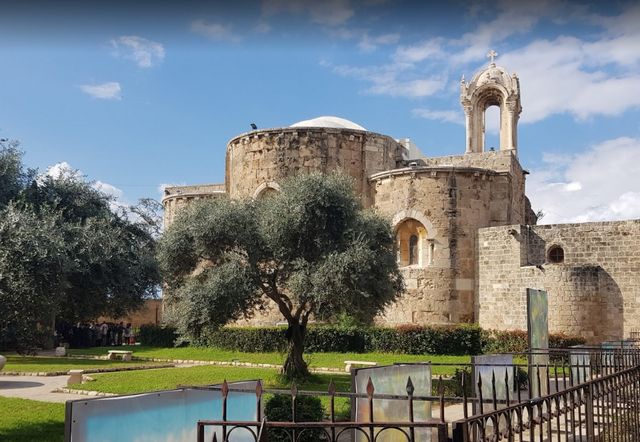
During his travels from Jerusalem to Antioch, Saint Peter established the first Christian community in Byblos. He appointed Saint John, also known as Mark, as its bishop to oversee its affairs. In the year 555, a devastating earthquake struck the entire Lebanese coast, including the church.
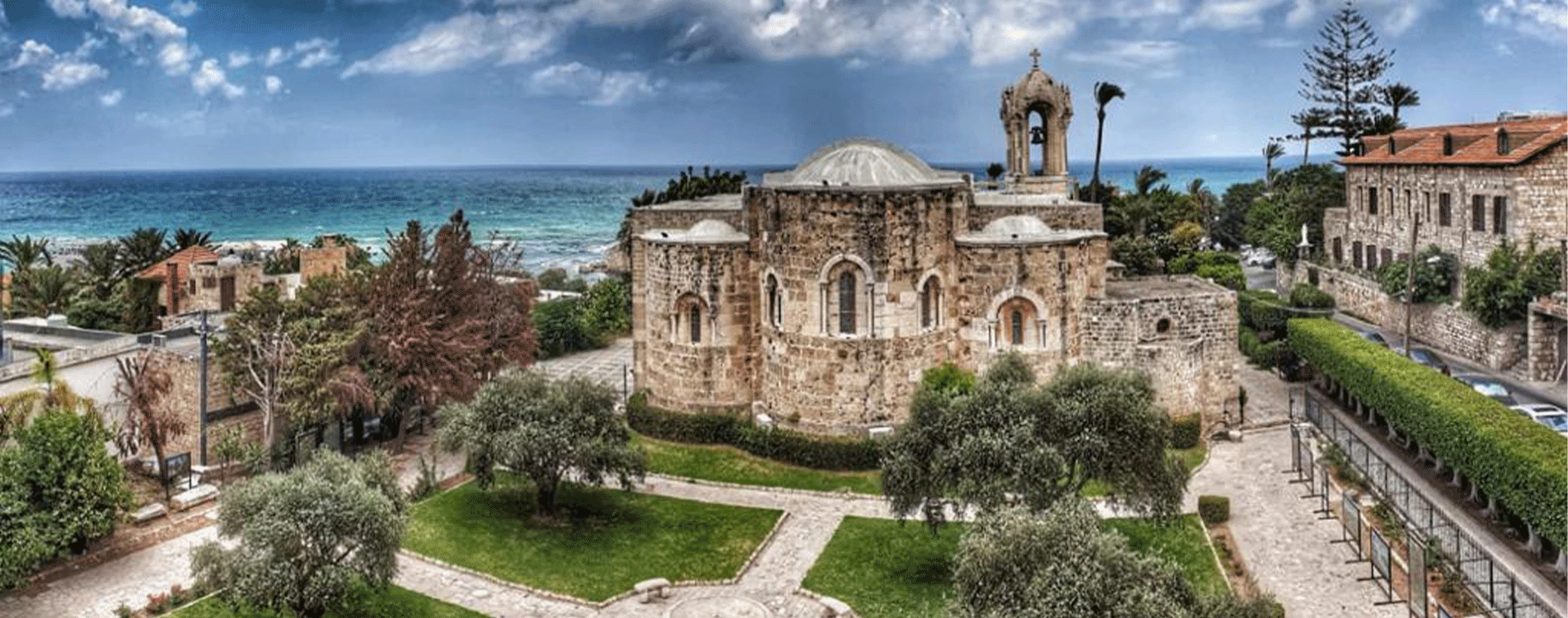
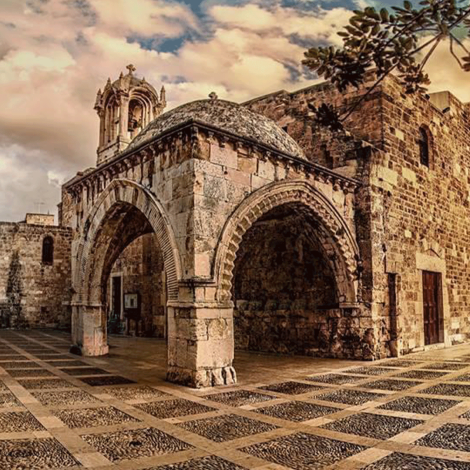
In 1111, the Crusaders began the construction of the current church, dedicating it to the Virgin Mary, fulfilling a vow they made during their siege of Byblos in 1103. The construction was completed in 1115. It is built in the Romanesque style, although it displays local and Byzantine architectural influences. This is evident in the dome of the baptistry, which dates to the thirteenth century. It is worth noting that this dome was adorned with a carved Corinthian stone piece, which was later transferred to the Louvre Museum in Paris.
In 1170, an earthquake struck the church, affecting its southern side, leading to its restoration during the twelfth and thirteenth centuries due to successive invasions by the Ayyubids, Crusaders, and Mamluks.
The period of Mamluk rule remains mysterious for the church. During the Ottoman rule, in the seventeenth century, a traveler reported that the church had been converted into a stable and a kitchen for the public and later into a military headquarters. It was divided into three floors: the first for horses, the second for soldiers, and the third for senior commanders.
In 1764, Prince Youssef Chehab handed over the dilapidated church, along with all the churches of Byblos, to the Lebanese Maronite Order, which restored it at its own expense and dedicated it to Saint John Mark, as indicated by the marble plaque at its northern entrance. The plaque reads, “This blessed structure was rebuilt during the reign of His Holiness Pope Pius VI, on the holy days of Patriarch Mar Youssef Estephan, with the help and support of Sheikh Saad Al-Khoury, under the divine guidance of Lebanese monasticism and the Maronite community. It was completed in 1776.”
In September 1840, during the uprising against the Egyptian occupation, the church was struck by the British navy from the sea, resulting in the collapse of its western facade. The Maronite Order restored it, at a cost of 8,000 piasters. It is said that the painting representing the Virgin Mary inside the church was donated as compensation for the damage it suffered.
In the early 20th century until 1937, the church was consecrated to Saint John the Baptist. The main altar was dedicated to honor him, as mentioned in the book by Camille Anlar.
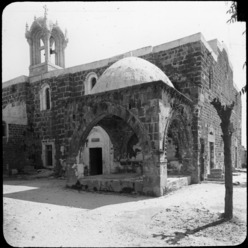
The construction of the current magnificent bell dome dates to the early twentieth century, between 1904 and 1910. The roof was reinforced and cast in cement after the removal of the earthen roof, which occurred in 1938. The stained-glass windows were executed by the famous French artist Gabriel Loire, who reshaped them to harmonize with the structure of the church.
It is worth mentioning that the Directorate General of Antiquities conducted excavations between 1970 and 1975, revealing a Byzantine mosaic that is currently displayed in the garden east of the church.
Lastly, it is important to note that the Lebanese Maronite Order has been serving the Church of Saint John Mark since 1766 to the present day.